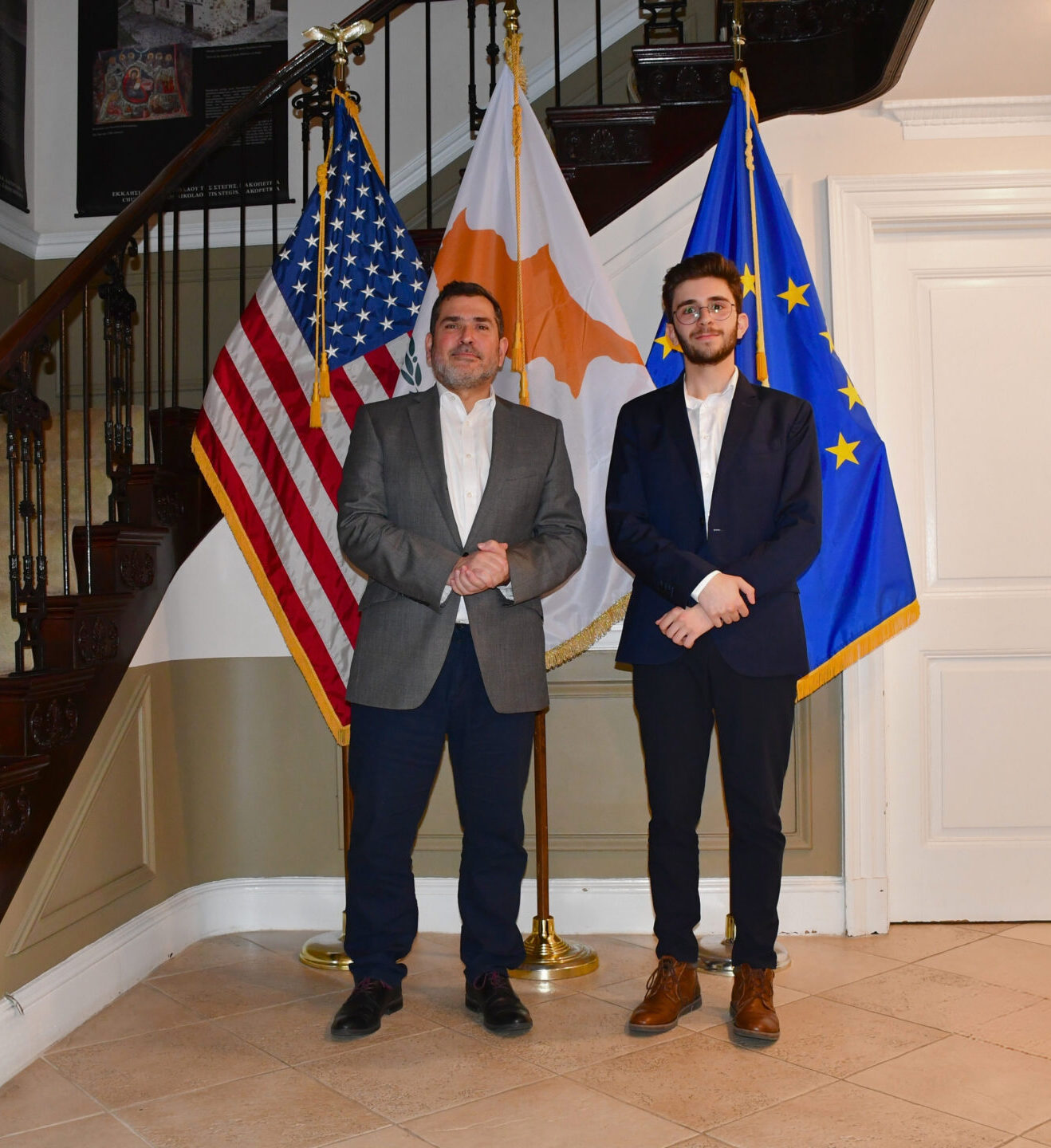
Ambassador Evangelos Savva is a seasoned diplomat with extensive experience in international relations and multilateral diplomacy. He currently serves as the Ambassador of the Republic of Cyprus to the United States of America, where he plays a key role in advancing Cyprus–U.S. relations and strategic cooperation. Over the course of his diplomatic career, he has held several senior positions within the Ministry of Foreign Affairs of Cyprus, contributing to the country’s foreign policy across bilateral and multilateral arenas. Ambassador Savva has also represented Cyprus in important international forums, including at the United Nations, where he has engaged in negotiations on global governance and regional security issues. A graduate in political science and international relations, he has developed particular expertise in diplomacy, international law, and European affairs, reflecting a career dedicated to strengthening Cyprus’s presence on the global stage.
Interview by Christos Charalambous, European Union G20 Youth Delegate (2026)
Hello everyone. My name is Christos Charalambous. I am an EU delegate for the 2026 G20 Youth Summit representing the Digital Transformation and Innovation track, and I’m joined here today by the Ambassador of the Republic of Cyprus to the United States of America, Mr. Evangelos Savva. Thank you for being here with us today.
Thank you. Thank you for having me.
Let us start right away and begin from Cyprus’ Presidency of the Council of the European Union. What are the priorities that Cyprus has set and what are the impacts that Cyprus is trying to achieve during this six month period?
Thank you very much for that question. I feel it is quite relevant and pertinent, especially being in the United States to be raising these questions, particularly because there is always an element of educating an American audience about what the European Union is and what it means to have the presidency. Cyprus has the rotating presidency of the Council of the European Union. We began on the first day of this year and it will run until the 30th of June 2026.
We officially announced our priorities the month before in December 2025, and let me remind everyone that we have a banner under which all these priorities come, and the banner is that Cyprus aims for a European Union that is autonomous but also open to the world. It is these two dimensions that we feel represent the vision moving forward for the European Union.
The European Union has always been, and aims to be even more, an actor that engages with everyone in the world with the aim of advancing peace and prosperity. Let us not forget that the European Union very correctly prides itself on being the most successful peace project in
the history of mankind. This is something we always aim to underline to American audiences and, as you know Christo, I engage quite often with universities and think tanks. I enjoy that part of the work a lot because it is needed.
It continues to be that way, and there is a strong emphasis on perpetuating that vision in every single corner of the world. Being open to the world is therefore crucial, and as presidency we aim to widen that scope even more. At the same time, we feel strongly about the need for the European Union to become more autonomous in a wide variety of policy fields. These include defence and security, economic competitiveness, digital sovereignty, and propagating our values around the world.
Very briefly, defence and security developments have shown constantly over the last few years, and perhaps one could say even right now as we speak, that the European Union now knows more than ever that it needs to really concentrate and focus its efforts on developing its own capabilities and not wait for anybody to act. So that’s an element that we feel very strongly about.
Economic and digital competitiveness is also important. I think everybody knows that the world is moving in the direction of a revolutionary transformation one could say, particularly with AI. Everybody keeps talking about AI. So we want to be able to advance our own vision as the European Union, and Cyprus aims to do its part as President of the Council right now.
Then we also want to make sure that within the European Union our values-based agenda is forwarded and upgraded as much as possible. We will never shy away from talking about values. Values are fundamental to the European Union vision. And again, this is something I always underline and stress in my engagement with the wider American public.
Expanding on that a little bit, and elaborating with the next question, beyond the Presidency how does Cyprus help shape, as the southeastern node of Europe and at the intersection of different continents, both the strategic and security policies and the overall outlook of the region?
I think that’s an excellent question. I think that’s a question that is so relevant right now as we speak. Look at the geographic location. Geography is everything. Geography is destiny. You cannot move your real estate anywhere else. You are where you are.
We are a small country, obviously, and that gives us an advantage. The advantage is that everybody knows we don’t have a strictly personal agenda. Our agenda is that the region is peaceful, that the region is stable, and that the region is prosperous. As a matter of fact, we firmly believe that without stability and without security you cannot have prosperity. It’s self
evident.
So being the southeastern edge of the European Union, if you like, a European country through and through, but at the same time located in the Middle East, we have always aimed to bridge these regions.
Allow me to say that in the last few years this expression has really taken root. We’ve had now a long run of governments and presidents, now with President Christodoulides, where we are making that transformation of showing everybody that Cyprus brings together these two geographical regions.
And we do it tangibly. We do it by being present and by having a significant diplomatic footprint in the Middle East. We have embassies everywhere. Believe me, it’s not the norm. If you go to the Gulf, not every European country has diplomatic missions there. We have diplomatic missions throughout the region and we bring people together. We feel we have a voice in Brussels that is highly respected and listened to by our European partners because of those connections and because of the work that we put in, with the President, the Foreign Minister, and the entire cabinet developing those relationships with the Gulf countries., so that we ensure that what we call the southern neighborhood, in European Union terminology, is not forgotten within the broader context of what the European Union tries to achieve in its immediate neighborhood.
Heading across the Atlantic now, as everyone knows the relationship between the United States and the European Union is one of the most important partnerships globally. How does Cyprus specifically help shape that relationship, and where does Cyprus fit into it?
Yes, again it’s a question that is becoming headline news practically every day. It’s also part of the priorities. We firmly believe that advancing the transatlantic partnership is crucial. It is absolutely essential that we continue to work with our partners in the United States. Everybody knows that the European Union is comprised of twenty-seven member states, many of them
also members of NATO. But beyond that, when we talk about the transatlantic relationship, we are talking about very strong bonds that extend across every policy area imaginable. Do not forget that the European Union is the largest trading partner of the United States. The European Union also provides the United States with its number one tourist market. This also creates strong people-to-people ties.
There is a strong affinity between European people and the American people. Secretary Rubio recently, in Munich, again made specific mention of the fact that the values between Europe and the United States have always underpinned by what we often call the Western values, but really they are human values, which characterize the relationship.
The transatlantic partnership is strong. It will continue to grow stronger, regardless of some issues where we may need to sit down and have honest and open discussions. This is the relationship, in international trade and international economic relations. It is also relevant when we talk about what we discussed before, the revolutions of the future, the technological revolution we are going through with AI. And we will get there. We need more discussion, we need more interaction, and Cyprus aims to advance that element as well.
Regarding Cyprus and the United States, and your role here in Washington D.C., what have been some significant events or milestones in recent years that have helped shape and strengthen the bilateral relationship between the two countries?
Yes, I mean the relationship over the last few years has really taken off. We were at a point in our relationship over the years, I would say around the middle of the previous decade, where the relationship was cordial and proper, but there wasn’t any particular bilateral interaction in many policy fields that you would normally expect. So this changed beginning, I would say, in 2018, when President Christodoulides, then as Foreign Minister, visited Washington and signed the Statement of Intent, as we call it, in November of 2018, advancing security cooperation between the United States and Cyprus.
And out of that it blossomed, particularly in security and defense. We created together with the United States a state-of-the-art training facility in Larnaca called CYCLOPS, which has been a resounding success. It has trained something in the area of 2,000 officials from like-minded countries in the region in security domains, but also in a number of other areas, and it has proven to be very useful.
We also moved in a direction between the Pentagon in the United States and our Ministry of Defense where military cooperation has really increased. We have now joint exercises. Cyprus became part of the so-called SPP program, the State Partnership Program, in which we partnered with the National Guard of New Jersey – another excellent success – and we’re excited to have more things to announce in the immediate future within that context. Also, the two ministries, the Department here and the Ministry in Cyprus, also came up with a roadmap of defense cooperation which is renewed every two years. We have visits by high-ranking military officers, including last year, by the way, the Chief of the National Guard, who had high-level contacts in the Pentagon.
So that aspect of security and defense is at the forefront. But beyond that, we have gradually transformed the relationship to the point where we have now established a strategic dialogue between the two countries.
During the visit of Foreign Minister Kombos in Washington in June of 2024, where he signed the Strategic Dialogue with then Secretary of State Antony Blinken., and then a few months later, a U.S. State Department contingent went to Cyprus and we held the first round. We are very excited that in the near future we expect to hold the second round here in Washington D.C.. So the Strategic Dialogue is a huge success.
Then, in October of 2024, President Christodoulides received an invitation from then President Joe Biden to visit the White House. This was a huge development. We had not had a visit by a President in Washington for a meeting in the Oval Office since 1996.
So after a long time that also took place, and it showed where we are today. Strategic partners with many items on our joint agenda, a lot of things to look forward to, and a lot of great work being done at every level to advance this relationship even further.
In that context, let me also mention the economic diplomacy dimension, where President Christodoulides visited the United States last year specifically to engage with economic actors and the private sector of the United States in New York, in Houston, and finally in Silicon Valley in the Bay Area in California, where we are now seeing the fruits of those contacts.
We now have increasing engagement with U.S. tech companies. We are seeing U.S. tech companies establishing a presence in Cyprus. Only yesterday there was a meeting again in Nicosia with representatives of U.S. tech companies in Cyprus, together with the Deputy Minister to the President and also the Deputy Minister for Innovation and Digital Transformation, Mr. Damianos. So we are seeing all these developments really giving us very
strong potential to deepen the relationship in that field, which would have been unthinkable a few years ago.
We are very excited about that, and I think it is already well known that this interest is only going to get stronger as we move forward, and we are here to do our very best to advance our agenda even further.
Having talked about both the transatlantic relations between the European Union and the United States and the bilateral relations between Cyprus and the United States, amidst regional tensions in the Middle East, how does Cyprus tangibly coordinate and collaborate with its partners to handle crises and manage these situations?
Well, first of all, over the years we have proven that, due to our location, due to the fact that we are a European Union member state, due to the relationship we now have with the United States, and due to the relationships we have with every single neighboring country, we have proven ourselves to be a very reliable hub for crisis management and humanitarian operations.
It has taken place time and time again where Cyprus is now almost a leading expert, if you like, in evacuating non-combatants from areas where there is conflict. We have done it in the past. We have done it in the recent past. Of course we never want to be put in that position simply because it means there is war and there is conflict, and we are always worried about those kinds of situations happening in our region.
But you have to live with reality, and this is what happens on occasion. We are now going through one of those occasions again, as everybody knows. So the region is facing a very unusual situation now, as we speak, and we are doing our part to make sure that those people who want to make their way to safety can use Cyprus in that regard. We cooperate with different countries in that direction. But again, this is also important. As a country with no agenda, we serve the purpose of being there when we are needed to do our part. We have done it in the past and we will do it again.
Looking ahead and into the future perhaps, what are your goals as the Ambassador of Cyprus to the United States?
Well, my goals are very simple. My goals are to advance the vision of the government and of the President to make this relationship as strong as possible. And believe me, every day we are engaged in that direction.
It is our job and our responsibility to make sure that all these different areas of cooperation and all these different policy fields move forward in as smooth a manner as possible, to make sure that the connections continue to exist and the channels of communication are there. We work very strongly not only within the administration, but let’s not forget there is also a very important dimension in the relationships we have built over the years with Congress, also using our wonderful diaspora and our people here, who are often very powerfully involved in building relationships with the higher echelons of power in the United States, both at the level of the administration and also on the Hill, with Congress. And we have seen this happen over and over again.
Advancing the EastMed Act in 2019 was a tremendous success. This was the basis on which many of the great things we are doing right now were built. So it is very important to continue engaging with Congress. We have seen, and we saw it with the EastMed Act, that there is wide bipartisan support for continuing on this path of strengthening the relationship. It does not matter which party. Both parties have again and again supported this direction.
We have also seen congressional delegations visit Cyprus recently. We had a very successful one again with a large contingent of senators visiting Cyprus and seeing firsthand what we do. They met with the President, and as always, these relationships are extremely valuable. You cannot put a price on meeting face to face and allowing them to see where we are on the map, what we do, and how we can work together.
The dividends that these visits pay cannot be measured. When they return from these visits and we meet with them again, they are very keen to explore even further cooperation. So we do all of that on an everyday basis with all our efforts.
It is a small embassy, but we do our part, and I look forward to engaging more and more. I look forward to getting out there and meeting people as much as I can. The United States is not only Washington D.C. This is the capital, but it is a federal system with 50 states. It is impossible to visit every single one, during a normal diplomatic tenure. We try to be everywhere you can.
We try to meet with professional associations, local politicians, universities, think-tanks, and the business community across the board to build these relationships because without them you cannot get anywhere.
So that is what we do. That is what we intend to continue doing. We bring forward the vision that the President has articulated for the bilateral relationship and try to make it happen as much as we can. And it is a privilege. It is a privilege to serve in this position in this country. It is a privilege to have a great team. It is a privilege to work under this President and this Foreign Minister in advancing these relations. Onwards and upwards.
Thank you so much, Ambassador Sava. I really appreciate you taking the time. Thank you.
